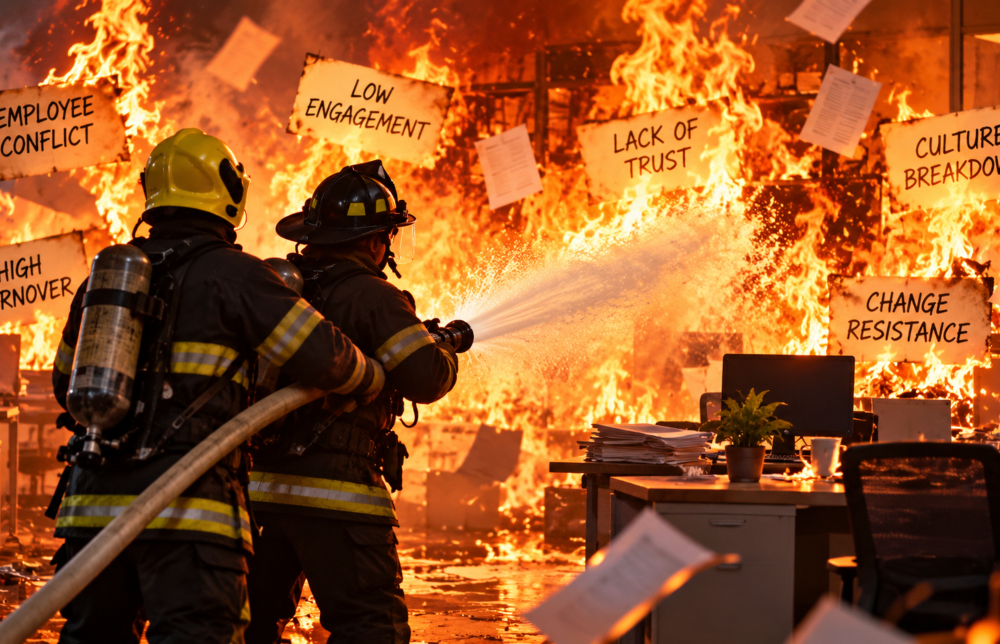


Firefighting Workplace Cultures: Warning Signs Your Company Is Addicted to Urgency and Sacrificing Performance
Is your organization moving fast — or just running in circles?
While change urgency is important to create momentum, too many organizations,
Welcome to the world of firefighting workplace cultures — where everything is urgent, everyone is exhausted, and a sustainable high performance culture remains frustratingly out of reach.
The greatest danger according to project postmortem analyses? Firefighting can feel like progress even when it is destroying team performance and organizational health.
Our corporate culture assessment research found that firefighting workplace cultures emerge when leaders repeatedly reward:
Over time, this unchecked and continuous sense of strategic urgency permeates every level of the organization, creating a workplace environment attuned to reacting to the latest crisis rather than making the thoughtful strategic tradeoffs required to perform over time.
The problem is not having an occasional crisis that demands attention.
The problem begins when urgency becomes the normal operating model.
6 Warning Signs Your Workplace Is Addicted to Firefighting
Through our action learning leadership development programs, we know that too many competing strategic priorities create confusion, fuel workplace politics, and undermine execution.
Our organizational alignment research reinforces the danger: When strategic clarity is lacking, employees become reactive rather than purposeful, busy rather than productive, and frustrated rather than engaged.
When everything is urgent, strategic leverage disappears — and firefighting becomes the default way of working.
When heroic rescues are rewarded more than diagnosing and eliminating root causes, organizations become trapped in an endless game of whack-a-mole — repeatedly reacting to preventable crises instead of building the strategic capacity required for sustainable high performance.
When being constantly available becomes more important than delivering meaningful results, decision making slows, accountability and ownership are inconsistent, and strategy execution suffers.
When doing (i.e., meeting immediate targets) becomes more important than being (i.e., doing things right), teams understandably begin cutting corners, bypassing critical business practices, postponing necessary improvements, and relying on temporary workarounds instead of addressing root causes.
Over time, these seemingly small compromises can accumulate into significant operational and cultural debt — creating larger, more complex, and more expensive problems down the road. Consider Wells Fargo’s fraudulent sales practices, Volkswagen’s emissions scandal, and PG&E’s catastrophic wildfire-related safety failures. While each involved different circumstances, they all illustrate the potentially devastating consequences of short-term thinking.
Without sufficient psychological team safety, employees become reluctant to challenge assumptions, surface risks, push back on unreasonable demands, or propose better alternatives. Instead, they quietly comply, make avoidable compromises, and hope for the best.
Over time, this culture of silence allows preventable problems to multiply while undermining the trust, accountability, and candid dialogue required for high performance.
The underlying assumption? Working harder, longer, and faster is the price of innovation, competitive advantage, and high performance.
But chronic overwork comes at a steep cost. Research from the World Health Organization (WHO) found that working 55 or more hours per week is associated with a 35% higher risk of stroke and a 17% higher risk of death from ischemic heart disease compared with working 35–40 hours per week.
Employee burnout is not evidence of excellence, and personal sacrifice is not a sustainable business strategy.
Reshaping a firefighting culture starts with strategy and leadership team behaviors. Leaders must fundamentally change how work gets designed, prioritized, rewarded, and executed.
This requires making explicit strategic assumptions and tradeoffs, aligning on what matters most and why, and having the discipline to stop or deprioritize work that does not directly support those outcomes.
Every new strategic priority must come with a corresponding tradeoff — stop something, deprioritizing something, or provide the additional resources required to execute successfully.
Otherwise, you are not setting priorities — you are creating the conditions for more firefighting.
Conduct a disciplined current-state analysis to distinguish symptoms from root causes, challenge assumptions, and identify the systemic issues driving repeated crises. If your team keeps fighting the same type of fires, stop reacting and reassess your approach.
The goal is not to become better at putting out fires — it is to eliminate the underlying conditions that keep starting them.
That means recognizing, developing, and promoting employees who think systemically, anticipate risks, improve processes, solve problems at their source, and eliminate unnecessary work. Equally important, establish fair and proportionate accountability for employees who repeatedly cut corners, ignore warning signs, or create avoidable emergencies.
The goal is to build a culture where preventing fires earns more recognition than putting them out.
Once strategic priorities and success metrics are aligned, establish explicit decision rights, clearly define individual and team goals and accountabilities, and ensure that performance expectations reflect operational realities. Then encourage employees to surface risks, challenge unrealistic deadlines, and renegotiate commitments before problems escalate.
The goal is to create a culture where people are accountable for delivering meaningful results — not just responding to the latest crisis.
Make these activities explicit leadership expectations, build protected time into your organization’s operating rhythm, and ensure leaders have the resources and capacity to follow through. Hold leaders accountable for improving how the business operates — not just keeping it running.
The goal is to create enough strategic capacity to prevent tomorrow’s crises while delivering today’s results.
To break the firefighting cycle, leaders must visibly and consistently demonstrate the desired behaviors they expect from others. They cannot demand strategic focus while continually introducing new emergencies, shifting priorities, or rewarding last-minute heroics. Use every decision, meeting, coaching conversation, and employee interaction to reinforce the desired ways of working.
The goal is to make strategic discipline contagious — because employees take their cultural cues from what leaders do, tolerate, reward, and prioritize.
The Bottom Line
While crisis management has its time and place, a culture of constant workplace firefighting is unsustainable. Firefighting workplace cultures are created when leaders and organizational systems model, reward, and tolerate the wrong behaviors. The goal is not to eliminate urgency — it is to reserve urgency for situations that genuinely deserve it.
If your organization’s hair is constantly on fire and struggling to meet strategic targets, the problem is probably deeper than poor time management. Download Is Your Workplace Culture Fueling Constant Firefighting? The 3 Levels of a High-Performance Culture Every Leader Must Get Right to learn how to build a culture that rewards prevention, accountability, and sustainable high performance.

Tristam Brown is an executive business consultant and organizational development expert with more than three decades of experience helping organizations accelerate performance, build high-impact teams, and turn strategy into execution. As CEO of LSA Global, he works with leaders to get and stay aligned™ through research-backed strategy, culture, and talent solutions that produce measurable, business-critical results. See full bio.



Aug 17,2026
 0
0

Feb 11,2019
13 K
Apr 18,2017
11 K

Nov 20,2016
6 K

Oct 02,2017
6 K
Explore real world results for clients like you striving to create higher performance