


“We turned to LSA to help us custom design and deliver a customized management development solution to help drive performance.
They have done an excellent job diagnosing the business situation, designing an approach that fits our culture, and delivering a first class solution with the support systems necessary to make a real difference.
I recommend LSA Global to anyone looking for real results.”
Sally Buchannan | VP Human Resources | Sony
“Wow! The plan for our managers is awesome. This is better than anything we had hoped for. Truly groundbreaking. I love it. Thank you!”
Troy A. Brown, Ed.D. | County Superintendent of Schools | San Joaquin County Office of Education
Today’s managers account for over one-third of the workforce and are facing challenges without precedent.
Managers are being asked to do more with less as their span of control increases. People managers report having to spend over half of their time on non-managerial tasks and as little as 10% of their time on what matters most — managing and coaching their front-line employees.
And even though Deloitte reported that companies invest the highest percent of their training dollars (35%) in management and leadership development, research by McKinsey found that:
This is bad news. Low performing managers make low performing companies.
The good news is that the flip side is also true: companies with higher performing managers realize an increase in profitability, productivity, employee engagement, customer satisfaction, and retention.
Based upon over 500,000 annual employee engagement surveys, we know that managers have a direct impact on four key metrics:
While focused management development can certainly play a critical role in improving performance, management skills alone will not fully address the growth, performance, and speed challenges faced by today’s managers.
Managers must also address strategies, cultures, processes, and structures to drive lasting change.
Our Organizational Alignment Research found that managers who effectively align culture and talent with business strategy achieve dramatically stronger results — including 58% faster revenue growth, 72% higher profitability, 9 times greater leadership effectiveness, and employee engagement levels that are 16.8 times higher.
Our study found that the highest performing managers consistently:
Our research-backed approach to management development helps managers thrive in the following areas:
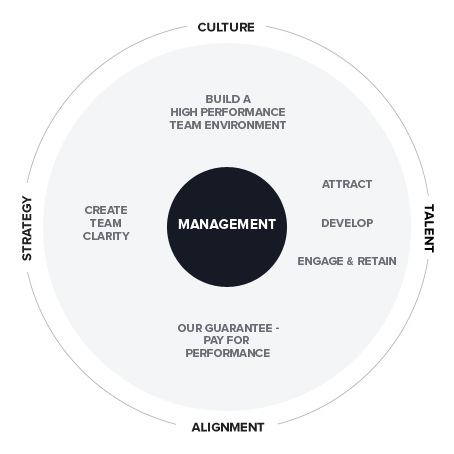
Please contact us to learn how our management development programs have helped leading organizations improve employee performance, employee engagement, employee retention and employee relations.
Ask us about Management Development Pay-for-Performance options and how to move the management metrics that you care most about. Typical metrics that we move include:








Management development focuses on helping managers improve day-to-day execution, team performance, employee engagement, communication, accountability, coaching, and operational effectiveness. Leadership development, by contrast, is more strategic and centers on setting direction, driving change, shaping culture, and aligning people around long-term business priorities. High-performing organizations typically invest in both because managers execute the strategy while leaders define and champion it.
Many management development programs fail because they rely too heavily on generic content that is disconnected from business strategy, culture, and real-world manager challenges. Research-backed programs are more effective when they are customized to the organization’s priorities, focused on measurable business outcomes, and reinforced through application, coaching, and accountability. According to McKinsey research, 75% of executives are dissatisfied with frontline manager performance, while 81% of managers are dissatisfied with their own performance — highlighting the need for more practical and aligned development approaches
Today’s managers need far more than technical expertise. The most effective management development programs strengthen skills such as coaching, communication, delegation, decision-making, emotional intelligence, change management, conflict resolution, accountability, strategic thinking, stakeholder influence, and performance management. Research consistently shows that managers who create team clarity, build high-performance environments, and actively develop talent have a direct impact on employee performance, engagement, retention, and customer satisfaction.
The best management development programs are tied directly to business metrics rather than participant satisfaction alone. Common success measures include employee engagement, retention, productivity, leadership effectiveness, customer satisfaction, revenue growth, operational efficiency, and manager readiness. Successful leadership and management development initiatives define measurable performance outcomes before training begins and track progress before, during, and after the program.
Managers have an outsized influence on the employee experience because they shape communication, expectations, recognition, development opportunities, and workplace culture on a daily basis. Managers directly impact employee performance, engagement, retention, and employee relations. Organizations with strong managers tend to experience higher productivity, stronger cultures, lower turnover, and better customer outcomes because employees are more likely to stay and perform at their best when they feel supported, challenged, and aligned with meaningful goals.
Explore real world results for clients like you striving to create higher performance


 Take Health Checks
 Get Toolkits
 Read Whitepapers


