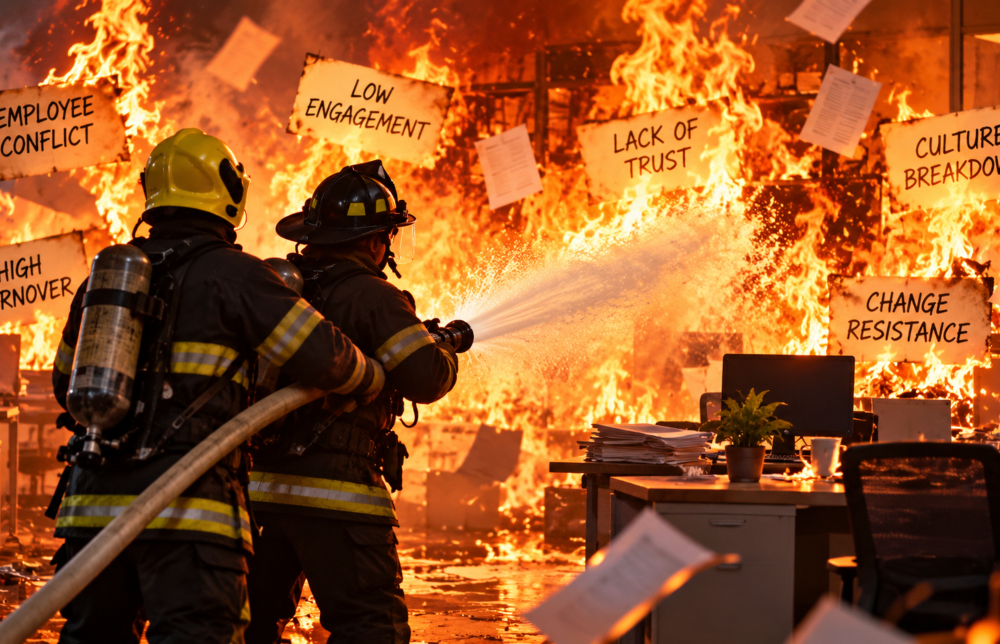


How to Handle Poor Performance Better Without Avoidance or Delay
Whether an entire team is underperforming or a single individual is falling short, managers are accountable for confronting and correcting performance gaps — directly and effectively.
Yet many managers hesitate when it matters most. They delay or avoid necessary conversations, not because they don’t recognize the issue, but because they want to:
That instinct is understandable — but it’s also costly.
Avoidance doesn’t preserve morale; it erodes it. It sends mixed signals, lowers standards, and places an unfair burden on high performers who are left to compensate. Over time, what feels like a short-term kindness becomes a long-term liability.
People manager assessment center data tells us that effective managers take a different approach. They:
Handled well, these difficult performance conversations don’t damage relationships — they strengthen them. They build trust, reinforce accountability, and create the clarity people need to succeed.
The real risk isn’t having the conversation. It’s avoiding it.
What the Research Reveals: Most Managers Avoid What Matters Most
The data is hard to ignore. A recent Harris Poll mirrors what we consistently see in organizational culture assessments:
This isn’t a marginal issue — it’s a systemic leadership gap.
At the core, new manager training participants struggle to reconcile two competing priorities:
When forced to choose, too many default to short-term harmony over long-term performance. The result? Vague expectations, inconsistent standards, and missed opportunities for growth.
But leadership doesn’t work that way.
Your effectiveness as a manager is inseparable from your team’s performance. And team performance hinges on clarity — clear expectations, clear feedback, and clear consequences. Without that, even the most capable employees are left guessing.
People don’t improve in the dark. They need to know exactly where they stand — what’s working, what’s not, and what needs to change. When that clarity is missing, performance stalls, frustration builds, and accountability fades.
Avoiding the conversation may feel easier in the moment. But in practice, it creates more discomfort, not less — for you, for the individual, and for the team as a whole.
No one wants to be part of a team that consistently falls short. Underperformance drains energy, erodes confidence, and lowers the bar for everyone. As a manager, the responsibility is clear — step in, create clarity, and do the work required to get performance back on track.
From what consistently works in practice, three actions make the difference:
Clarity alone is not enough. Expectations must also feel credible and fair. When expectations are vague, unrealistic, or inconsistently applied, performance conversations quickly break down.
Effective expectations share a few non-negotiable qualities — they are clear, relevant, measurable, consistent, timely, and achievable. Just as important, they are understood. If team members cannot articulate what success looks like in their own words, alignment is not there yet.
Finally, be explicit about consequences. People should understand both the rewards for strong performance and the implications of falling short. Ambiguity here undermines accountability.
This kind of visibility creates a natural form of accountability. High performers stay motivated, while those who are struggling have a clearer path to improvement. It also enables peer-to-peer ownership, where team members can challenge, support, and learn from one another without waiting for management intervention.
Without transparency, underperformance can hide. With it, performance gaps become easier to address — early and constructively.
If you want a culture of accountability, reduce ambiguity. Make goals, progress, and outcomes part of the everyday conversation.
Set the tone by leading with openness and respect. Address performance issues directly, focusing on behaviors and outcomes rather than personalities. Encourage constructive disagreement, where ideas can be challenged without creating friction between people.
Consistency matters. When managers demonstrate that honesty, accountability, and follow-through are non-negotiable, those behaviors become embedded in the team’s operating rhythm.
Leadership is not about delivering occasional feedback — it is about creating an environment where performance conversations are normal, expected, and productive.
The Bottom Line
Managing performance is demanding work. It requires discipline, clarity, and the willingness to have conversations others avoid. But when done well, it transforms teams. Set clear expectations, make performance visible, and lead by example — and you create the conditions where accountability and high performance can take hold.
To learn more about how to handle poor performance, download The Research Behind Performance Expectations that Managers Need to Know

Tristam Brown is an executive business consultant and organizational development expert with more than three decades of experience helping organizations accelerate performance, build high-impact teams, and turn strategy into execution. As CEO of LSA Global, he works with leaders to get and stay aligned™ through research-backed strategy, culture, and talent solutions that produce measurable, business-critical results. See full bio.



Aug 17,2026
 0
0

Feb 11,2019
13 K

Apr 18,2017
11 K

Nov 20,2016
6 K

Oct 02,2017
6 K
Explore real world results for clients like you striving to create higher performance