


“LSA Global’s training measurement and ability to measure the impact of their work is second to none. They helped us to directly correlate our initiatives to key customer behaviors and sales.
Thanks again LSA!”
David Fiano | Director of Merchandising | Sony
We pride ourselves on evaluating, measuring, and quantifying the impact of training and development. Our training measurement services align and help to support our core belief in the Transfer of Training™ and the required impact on the business through increased revenue, decreased costs, and/or increased productivity.
We believe that the measurement and evaluation of training programs is important for three reasons:
1. To Track and Measure Business Results
2. To Drive Accountability for Execution
3. To Provide Feedback for Coaching that is:
While creating the foundation for accountability and reinforcement, our training measurement and evaluation services allow you to determine if people are using the skills, the specific impact of the new skills, and what to do next.
Post-Workshop Skill Application, Coaching, & Training Measurement
In addition to our standard workshop satisfaction metrics, LSA offers four additional training measurement, evaluation, and coaching options for each workshop:

1. Are They Using It?
Training Adoption Metric™ measurement and evaluation surveys are used to track application and results of new skills and approaches 60-90 days after the initial training. This combination of Level 3 and Level 4 measurement captures both leading and lagging indicators of performance. Each survey typically includes:
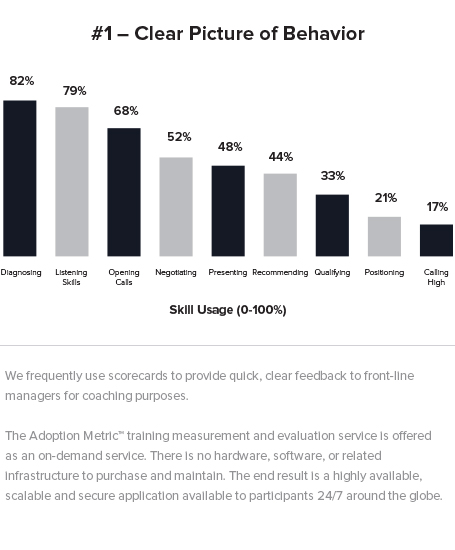
View an example Case Study demonstrating the Adoption Metric™ approach to Level 3 and Level 4 training measurement and where we have successfully done this before.

2. What Difference is it Making?
Training Impact Metric™ is a careful blend of academic rigor and real-world practicality. Our eight step training measurement and evaluation process begins with an evaluation of the business goals and challenges to be addressed by the training. Through executive-level conversations, we work with you to identify one to three training metrics directly impacted by the learning initiative and aligned with the business goals.
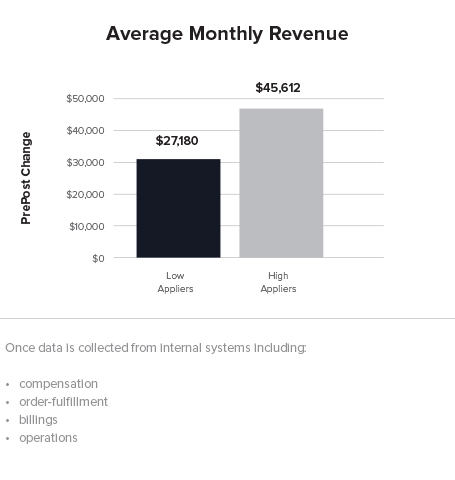
View an example Case Study to see the Impact Metric™ process in action and where we have successfully done this before.
Impact Metric™ is a new training evaluation approach that isolates the results produced by learning solutions comparing high and low adopters of the targeted skills. It controls for most other factors, including age, experience, tenure, location, competitors, market changes, and pricing changes. The result is a clear picture of the “definite difference” made by new skills used back on the job — typically quantified in financial terms.
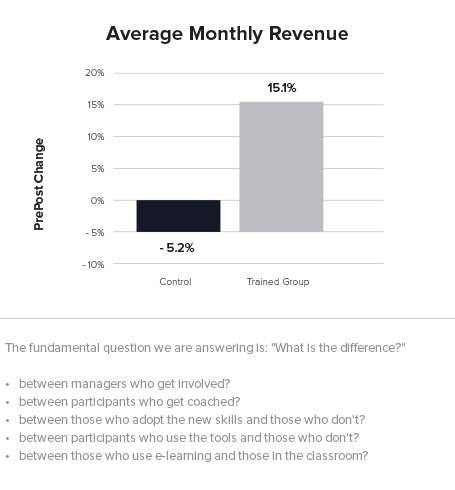
Why look for the difference?
To answer the questions: “How can you isolate the impact of the training? Doesn’t a rising tide lift all boats? Aren’t there just too many outside influences and variables?”
Traditional training measurement and evaluation methods address this issue using control groups or calculating Return on Investment (ROI). Both have serious limitations. First, reliable control groups rarely exist in the real world. Second, an ROI statistic is typically too small to show the full impact of training, too big to be believed, and too complex to be easily understood.

3. What should I do differently?
Individual Coaching™ Plans provide a true learning and performance accountability system. It helps you answer the question, “How’s it going to be different this time?”
Individual Coaching™ Plans provide personalized coaching profiles (8-12 pages) for each participant to show on the job application for key skills and strategies. As a coaching guide, Individual coaching™ Plans highlight areas of progress and obstacles, benchmarks against peers, and links to specific tools and resources for areas of deficiency.
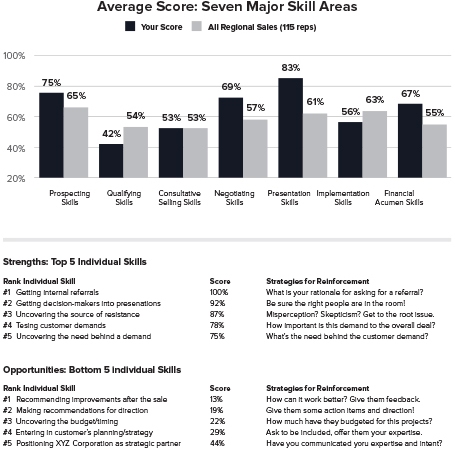
LSA Global delivers training measurement and evaluation in more than a dozen languages simultaneously including English, French, Spanish, Portuguese, Dutch, Hebrew, Swedish, German, Chinese, Japanese, Korean and Thai.
If you would like to learn how our measurement and evaluation expertise has helped leading organizations across multiple industries measure the impact of training and development, please contact us.















Training measurement ensures that learning initiatives translate into measurable business outcomes rather than isolated training events. Effective measurement helps organizations determine whether employees are applying new skills, whether managers are reinforcing desired behaviors, and whether training investments are improving revenue, productivity, customer satisfaction, or operational efficiency. It also creates accountability and provides actionable feedback for coaching and continuous reinforcement.
LSA Global uses a research-based approach that combines training adoption metrics, business impact analysis, coaching reinforcement, and post-training evaluation. Their methodology measures both leading indicators — such as skill adoption and manager reinforcement — and lagging indicators like business results, sales performance, productivity gains, and customer outcomes. The goal is to isolate the measurable difference created by training initiatives in real-world business environments.
Training Adoption Metrics™ focus on whether participants are actively applying newly learned skills and behaviors back on the job. These measurements typically occur 60 to 90 days after training and assess usage, reinforcement, and coaching activities. Training Impact Metrics™, on the other hand, evaluate the broader business results tied directly to the learning initiative by comparing high adopters versus low adopters while controlling for outside variables. Together, they provide a comprehensive view of both behavior change and business impact.
Organizations improve training transfer by combining learning experiences with manager involvement, coaching reinforcement, accountability systems, and practical on-the-job application. Successful programs include clear expectations, follow-up coaching, measurable performance goals, and ongoing feedback loops. Personalized coaching plans and post-training reinforcement significantly increase the likelihood that employees will sustain new behaviors and deliver measurable business results.
Effective training measurement can improve a wide range of organizational outcomes, including sales growth, employee productivity, leadership effectiveness, customer loyalty, employee engagement, retention, operational consistency, and profitability. By identifying which learning initiatives create the strongest business impact, organizations can make smarter talent investments and continuously optimize workforce performance.
Explore real world results for clients like you striving to create higher performance


 Take Health Checks
 Get Toolkits
 Read Whitepapers


