Practical HR Handbook: How to Implement Manager Coaching That Drives Measurable Results What if there were a practical, no-nonsense HR handbook to help managers coach in ways that actually move the needle?
While ownership for leadership and coaching should never sit solely with HR, HR plays a critical role in creating the conditions for:
Consistency.
Clarity.
Accountability.
Done well, HR doesn’t “own” coaching — it operationalizes it. That means embedding simple, repeatable coaching practices into how managers lead their teams every day, not just what they learn in a customized training program.
A well-designed coaching approach ensures that conversations are not left to chance or personality. Instead, they become a core leadership expectation:
When integrated into every new manager development experience, coaching shifts from a nice-to-have skill to a standard way of working. The result is:
More engaged employees.
Stronger capability building.
Better performance outcomes.
The 6 Step HR Handbook to Implementing Manager Coaching
Use this six-step HR handbook to make manager coaching a disciplined, scalable part of your management development program — not an occasional activity that depends on individual style or intent.
Set Clear Expectations
Start by removing ambiguity. Define what “good” coaching looks like in your organization and why it matters. Position manager coaching as a non-negotiable component of your talent management strategy — not an optional leadership trait. Be explicit about the outcomes you expect, from stronger performance to deeper engagement and retention.
Educate Managers On Their Role People managers are the linchpin. If they misunderstand coaching, the entire effort stalls. Clarify that coaching is not about fixing problems in the moment — it’s about building long-term capabilities and high performing teams. Equip managers with practical tools, conversation frameworks, and real examples so they can coach with confidence.
Create Structure and Practical Templates
Consistency doesn’t happen by accident. Provide simple, usable structures for different coaching scenarios — developmental conversations, performance redirects, and career growth discussions. Templates, question guides, and clear conversation flows reduce guesswork and increase quality, especially for less experienced managers.
Establish a Coaching Cadence
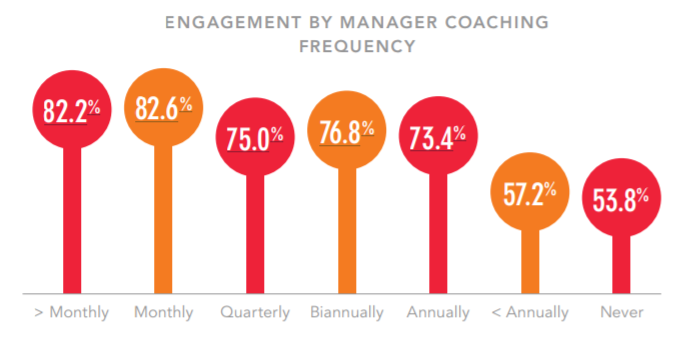
Frequency matters more than intensity. Set a clear expectation for how often coaching should occur and reinforce it through routines. Organizational Culture Assessment Research consistently shows that monthly coaching conversations significantly increase engagement, while inconsistent or infrequent coaching correlates with increased disengagement. Make coaching a rhythm, not a reaction.
Reinforce Two-Way Dialogue Coaching fails when it becomes one-sided. Managers who dominate conversations miss the point entirely. Effective coaching requires active listening, curiosity, and the discipline to ask more than tell. Managers need to understand individual motivations, barriers, and aspirations before they can influence performance in a meaningful way.
Track, Measure, and Hold Accountable What gets measured gets sustained. Define how you will evaluate the effectiveness of manager coaching — whether through employee engagement scores, performance improvements, retention metrics, or internal mobility. Monitor participation and quality, not just completion. Then hold managers accountable for integrating coaching into how they lead, not just checking a box.
The Bottom Line
85% of hostile employees don’t receive enough coaching from their boss. When management coaching works, it develops a coaching culture of empathy and trust ready to handle both the good and bad times. Invest in developing your top talent with an HR Handbook to Implement Manager Coaching.
Tristam Brown is an executive business consultant and organizational development expert with more than three decades of experience helping organizations accelerate performance, build high-impact teams, and turn strategy into execution. As CEO of LSA Global, he works with leaders to get and stay aligned™ through research-backed strategy, culture, and talent solutions that produce measurable, business-critical results. See full bio.