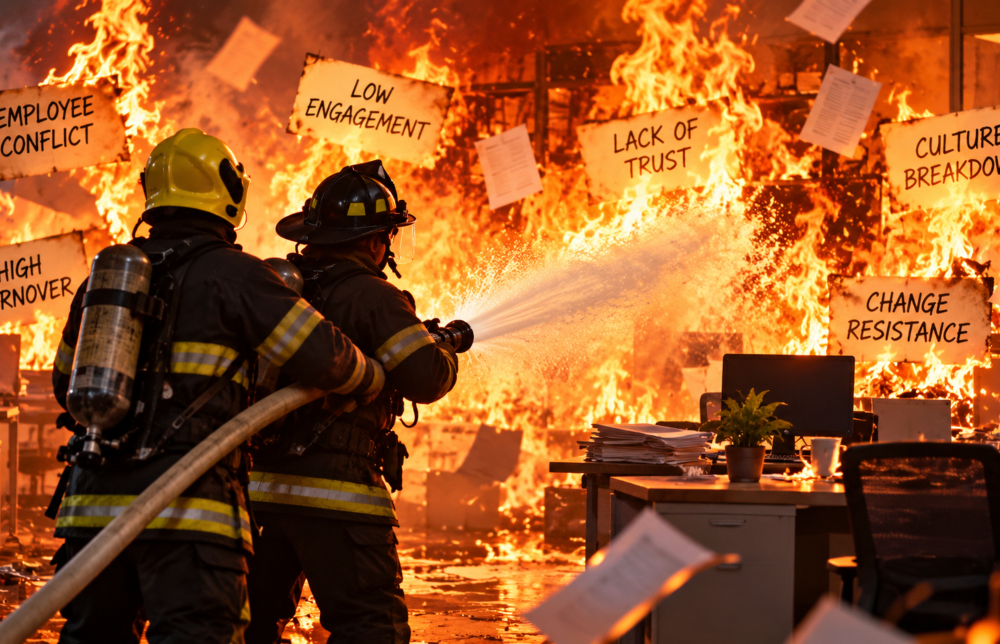


How Unwritten Rules Shape Corporate Culture
Corporate culture is more than a set of stated values hanging on a wall. It is the collection of everyday behaviors, decisions, and interactions that determine how work actually gets done. While mission statements, policies, and organizational structures matter, our organizational culture assessment research shows that unwritten rules shape corporate culture even more. These hidden team norms influence what employees believe is:
Like an ocean current beneath the surface, unwritten rules often determine where an organization ultimately goes, regardless of the course leaders intend to steer.
The Hidden Forces Behind Every Workplace Culture
Imagine your organization as a ship crossing open water. The visible elements — charts, navigation systems, and equipment — represent your formal strategies, values, policies, and business practices. They provide direction, but they do not determine every outcome.
Below the surface are the currents, tides, and winds that influence speed and direction. Those hidden forces represent the unwritten rules that shape corporate culture.
These informal rules develop over time through leadership behavior, peer interactions, reward systems, and repeated experiences. Employees quickly learn what is actually valued by observing:
These daily signals become far more influential than an employee handbook.
When Unwritten Rules Conflict with Stated Values
The strongest cultures align formal values with informal behaviors. Problems arise when they contradict each other.
For example, an organization may proudly declare that it values innovation, yet employees quickly learn that failed experiments damage careers. The real unwritten rule becomes:
“Don’t take risks.”
Likewise, leaders may encourage a culture of collaboration while rewarding individual performance above all else. Employees naturally compete instead of cooperating because incentives speak louder than slogans.
Over time, these inconsistencies create confusion, frustration, and disengagement while weakening trust in leadership.
How Unwritten Rules Influence Performance
Every organization has unwritten rules that either accelerate or limit performance.
Healthy unwritten rules encourage people to:
Unhealthy unwritten rules encourage employees to:
Because these behaviors become normalized, many organizations mistake them for “just the way we do things around here.”
The Impact on Employee Engagement and Retention
Employees rarely leave because of a company purpose or direction. They leave because of daily experiences.
When unwritten rules reinforce respect, inclusion, learning, and accountability, employees are far more likely to stay engaged and committed. Conversely, when hidden expectations reward workplace politics, discourage transparency, or punish initiative, top performers often disengage or seek opportunities elsewhere.
Culture is ultimately experienced through everyday interactions — not through executive communications.
How Leaders Can Change Unwritten Rules
Changing corporate culture requires changing the behaviors that define it.
Leaders can begin by:
Culture changes when employees repeatedly observe that new behaviors are expected, rewarded, and sustained over time.
Our organizational alignment research found that culture explains 40% of the difference between high- and low-performing organizations. Because unwritten rules largely determine culture, they also have an outsized influence on execution, innovation, customer satisfaction, and long-term business performance.
The Bottom Line
Unwritten rules shape corporate culture far more than most organizations realize. They influence how employees make decisions, collaborate, solve problems, and serve customers every day. When hidden norms reinforce your strategy and stated values, culture becomes a strategy accelerator. When they contradict your intentions, they undermine performance. The most effective leaders continuously identify, challenge, and reshape the unwritten rules that define how work truly gets done.
To discover how hidden norms influence behavior, execution, and business results, download The 3 Levels of Culture Every Leader Must Get Right to Build High Performance

Tristam Brown is an executive business consultant and organizational development expert with more than three decades of experience helping organizations accelerate performance, build high-impact teams, and turn strategy into execution. As CEO of LSA Global, he works with leaders to get and stay aligned™ through research-backed strategy, culture, and talent solutions that produce measurable, business-critical results. See full bio.



Aug 17,2026
 0
0

Feb 11,2019
13 K
Apr 18,2017
11 K
Nov 20,2016
6 K

Oct 02,2017
6 K
Explore real world results for clients like you striving to create higher performance