

A Situational Approach To Management: Done Well, Performance Management is a Partnership
Research consistently shows a significant gap between what employees expect from their leaders and what they actually experience at work. These disconnects affect both new managers and experienced leaders alike. One major reason is that too few leaders adapt their management style to meet the needs of individual employees and situations.
In fact, research on a situational approach to management reveals that only 54% of leaders consistently adjust their leadership style based on the competence and commitment of their people. That means leaders are often using the wrong leadership approach at the wrong time.
When left unaddressed, these leadership gaps reduce organizational effectiveness by:
How to Help Managers Lead More Intentionally
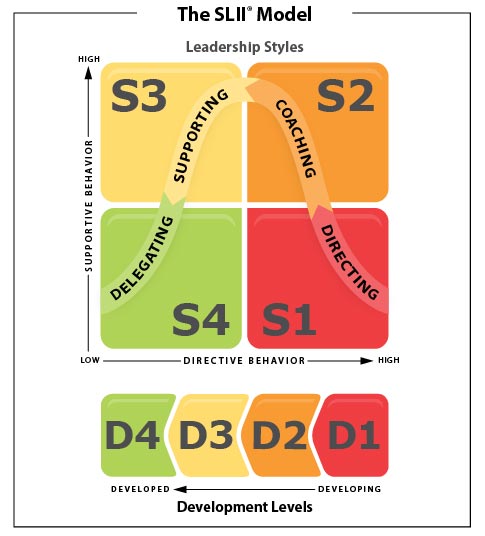
Developed by Ken Blanchard, SLII® is a proven situational approach to management that helps leaders become more:
The goal is to build high-performing teams where employees clearly understand expectations, feel supported, and stay aligned around shared organizational goals.
Done well, performance management becomes a true partnership between managers and employees rather than a one-sided process focused solely on evaluation. Managers and direct reports learn to communicate using a shared language that strengthens:
Leaders learn how to provide the right balance of direction and support based on the specific task, goal, or situation. Just as important, they learn when to adjust their leadership style as employee needs evolve.
Too Much Direction Can Be as Harmful as Too Little
Managers often assume that providing more oversight automatically improves results. In reality, leadership effectiveness depends on matching the right level of support and direction to the situation.
Providing excessive direction to highly capable employees can feel like micromanagement and erode motivation. On the other hand, offering too little guidance when employees are uncertain or inexperienced can create frustration, confusion, and feelings of abandonment — especially when stakes are high or difficult decisions must be made.
The most effective leaders avoid both extremes. They flex their approach based on what each person needs to succeed in that moment.
The Best Leaders Use a Situational Approach to Management
Research involving hundreds of thousands of employees confirms that the best leaders are situational leaders. They accurately assess individual needs and adapt their leadership style to fit the:
Situational leaders understand that leadership is not something done to people — it is something done with people.
The Bottom Line
Great managers are not born with perfect leadership instincts. They learn how to adapt, communicate, and lead intentionally. A situational approach to management helps leaders provide employees with the right balance of direction and support at the right time — improving trust, engagement, execution, and long-term performance.
To learn more about taking a more situational approach to management, download 7 Immediate Management Actions to Align Teams, Accelerate Execution, and Achieve Goals

Tristam Brown is an executive business consultant and organizational development expert with more than three decades of experience helping organizations accelerate performance, build high-impact teams, and turn strategy into execution. As CEO of LSA Global, he works with leaders to get and stay aligned™ through research-backed strategy, culture, and talent solutions that produce measurable, business-critical results. See full bio.



Aug 17,2026
 0
0

Feb 11,2019
13 K

Apr 18,2017
11 K

Nov 20,2016
6 K

Oct 02,2017
6 K
Explore real world results for clients like you striving to create higher performance