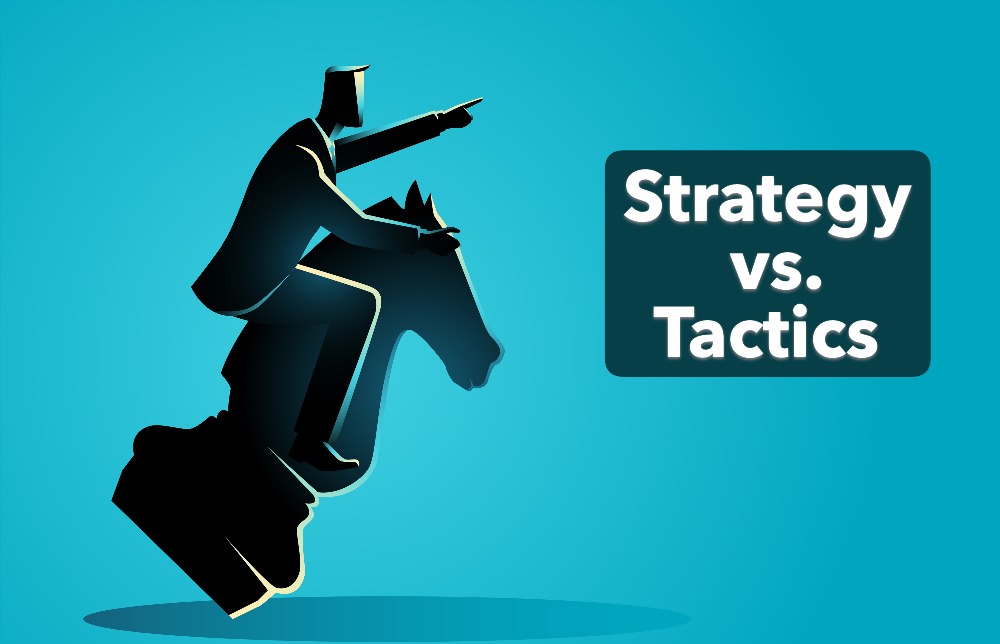


Strategy vs. Tactics: Why Understanding the Difference Matters
At our clients, we keep noticing that teams are confusing strategy and tactics. Leaders say they are “working on the strategy” when they are really discussing imminent tactics. Teams claim they are executing tactics when they are actually making strategic choices that shape where the organization is headed.
We know from strategy planning retreats that this seemingly harmless mix-up can create real people and performance problems because it causes issues with:
In the strategy vs. tactics debate, here’s our take:
Strategy Defines the Playing Field
Our organizational alignment research found that strategic clarity accounts for 31% of the difference between high and low performance in terms of revenue growth, profitability, customer loyalty, leadership effectiveness, and employee engagement. A well-formed strategy forces leaders to make difficult choices. It defines the:
A winning strategy requires more than aspirational goals, hard work, and disconnected initiatives. It requires ruthless focus, difficult trade-offs, and organizational alignment.
Tactics Translate Strategy into Action
While strategy determines the playing field, tactics are the specific initiatives, programs, campaigns, and operational decisions that support the broader strategic direction.
Tactics tend to be shorter term and must evolve as conditions change and as organizations learn what works and what does not. A marketing campaign, a product launch, a pricing promotion, or a sales training program are all examples of tactics.
Effective tactics move the overall strategy forward. When the relationship between the two is clear, teams understand how their work contributes to larger goals. When the connection is unclear, organizations experience what many leaders describe as “activity without progress” or “strategic drift.”
Research published in the Strategic Management Journal demonstrates that firms with strong alignment between strategic intent and operational actions significantly outperform competitors in terms of long-term financial performance. The implication is straightforward: tactics matter, but only when they reinforce a coherent and aligned strategic direction.
Why Organizations Confuse the Two
Change management consulting experts highlight three factors that contribute to the confusion between strategy vs. tactics.
Strategy vs. Tactics: 5 Key Reasons The Distinction Is So Important
In other words, people stay busy but performance and engagement drifts.
This strategic decision making concept is central to the work of Michael E. Porter, who showed that sustainable competitive advantage requires organizations to make distinct choices about where to compete and how to differentiate themselves. Without those choices, companies tend to imitate competitors rather than develop a unique value position.
Tactics typically do not require these kinds of fundamental decisions. They focus on strategy execution. Understanding the difference helps leaders concentrate on what matters most to the success of the overall business.
When the distinction is unclear, teams create their own — often misaligned or conflicting — priorities. One group may focus on growth at all costs, another on efficiency, another on risk mitigation, and another on innovation. The result is fragmented effort, internal friction, and workplace politics.
A clear and committed to strategy provides the North Star that keeps strategy execution aligned.
Strategy provides direction, meaning, and stability. Tactics provide actions, deliverables, and flexibility.
Strategic decisions typically require deeper analysis, cross-functional input, and long-term consideration. Tactical decisions determine the specific actions taken to support the strategic direction.
This clarity prevents both overanalyzing small decisions and rushing through major strategic ones.
The Bottom Line
Strategy determines the destination. Tactics determine the steps taken along the way. When leaders manage both deliberately, they create the focus and alignment required for peak performance.
To learn more about strategy vs. tactics, download 7 Proven Ways to Stress Test Your Strategy

Tristam Brown is an executive business consultant and organizational development expert with more than three decades of experience helping organizations accelerate performance, build high-impact teams, and turn strategy into execution. As CEO of LSA Global, he works with leaders to get and stay aligned™ through research-backed strategy, culture, and talent solutions that produce measurable, business-critical results. See full bio.



Aug 17,2026
 0
0

Feb 11,2019
13 K
Apr 18,2017
11 K
Nov 20,2016
6 K

Oct 02,2017
6 K
Explore real world results for clients like you striving to create higher performance