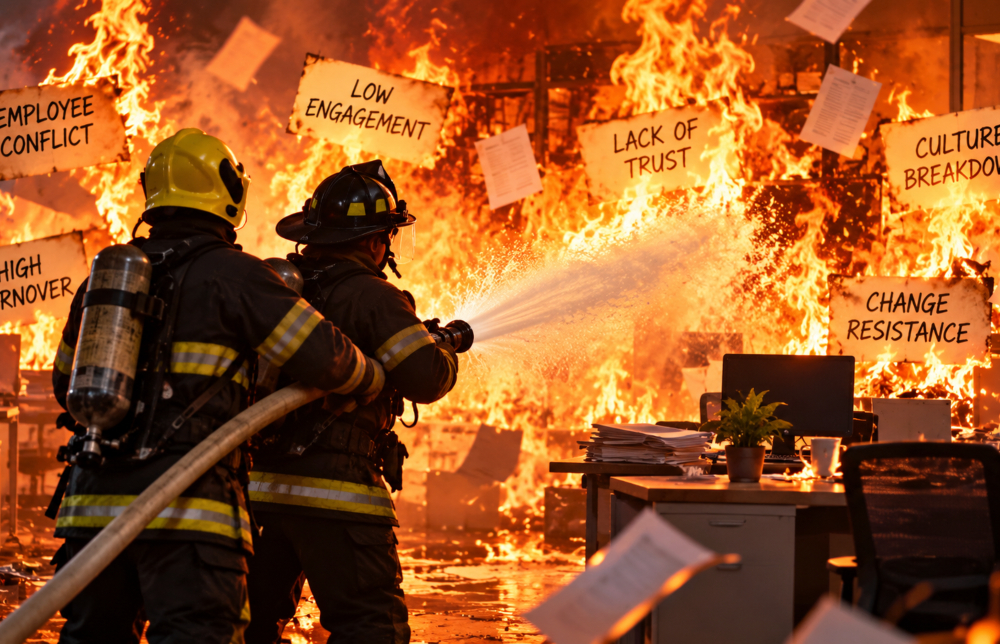
Psychological Team Safety: Is Your Leadership Team Too Afraid to Tell the Truth?
The most dangerous leadership teams aren’t always dysfunctional — sometimes they’re just too polite.
But what if that apparent harmony is actually your biggest performance risk?
Too many leaders who take our leadership simulation assessment confuse silence with alignment, politeness with trust, and agreement with commitment. When employees hesitate to challenge assumptions, question decisions, or raise concerns, psychological team safety is dangerously low — even when everything looks fine on the surface.
For high-performing leadership teams, psychological safety is not a soft leadership concept. It is a prerequisite for strategic clarity, effective decision-making, innovation, and successful change management initiatives.
Harvard Business School professor Amy Edmondson defines psychological safety as a shared belief that a team is safe for interpersonal risk-taking.
Her influential 1999 research, published in Administrative Science Quarterly, found that psychological safety was associated with learning behavior in work teams — a critical ingredient for improving performance.
Similarly, our action learning leadership development participants and Google’s Project Aristotle identified psychological safety as the most important of five dynamics distinguishing effective teams.
The implications for leaders are significant: If people cannot safely challenge the thinking behind your strategy, how can you trust their commitment to executing it?
Psychological safety does not mean avoiding conflict, lowering standards, or making everyone comfortable. It means creating the conditions for constructive debate, honest feedback, and a culture of accountability without fear of humiliation or retaliation.
5 Warning Signs Your Leadership Team Lacks Psychological Safety
Our organizational culture assessment research uncovered that low psychological safety often hides behind seemingly productive behaviors:
These behaviors undermine strategic alignment and create a culture where people manage impressions instead of solving problems.
Before your next executive strategy retreat, ask team members to evaluate these statements confidentially. If you do not get consistently “safe” answers, your leadership team needs to work on being more open to debate and constructive dissent before moving forward.
The first seven are adapted from Edmondson’s psychological safety assessment; the remaining thirteen evaluate broader team effectiveness.
Pay particular attention to gaps between what leaders believe and what employees experience. Reverse-score negatively worded items and examine patterns rather than relying on a single overall score.
The Bottom Line
The greatest threat to team interdependence may not be conflict — it may be the important conversations that never happen. Without psychological team safety, leaders sacrifice candor, accountability, innovation, and strategic execution to preserve superficial harmony. High-performing teams do not eliminate disagreement. They create enough trust to confront difficult truths and enough discipline to turn those conversations into measurable results.
The question is not whether your leadership team gets along. It is whether people feel safe enough to tell each other what they really think when the stakes are high.
When fear replaces candor, silos strengthen, trust erodes, and performance suffers.
To learn how high-performing leaders create the trust, openness, and accountability needed to break down these barriers, download Are Organizational Silos Killing Performance? How Great Leaders Break Down Barriers and Resolve Costly Conflicts

Tristam Brown is an executive business consultant and organizational development expert with more than three decades of experience helping organizations accelerate performance, build high-impact teams, and turn strategy into execution. As CEO of LSA Global, he works with leaders to get and stay aligned™ through research-backed strategy, culture, and talent solutions that produce measurable, business-critical results. See full bio.



Aug 17,2026
 0

Feb 11,2019
13 K
Apr 18,2017
11 K

Nov 20,2016
6 K

Oct 02,2017
6 K
Explore real world results for clients like you striving to create higher performance