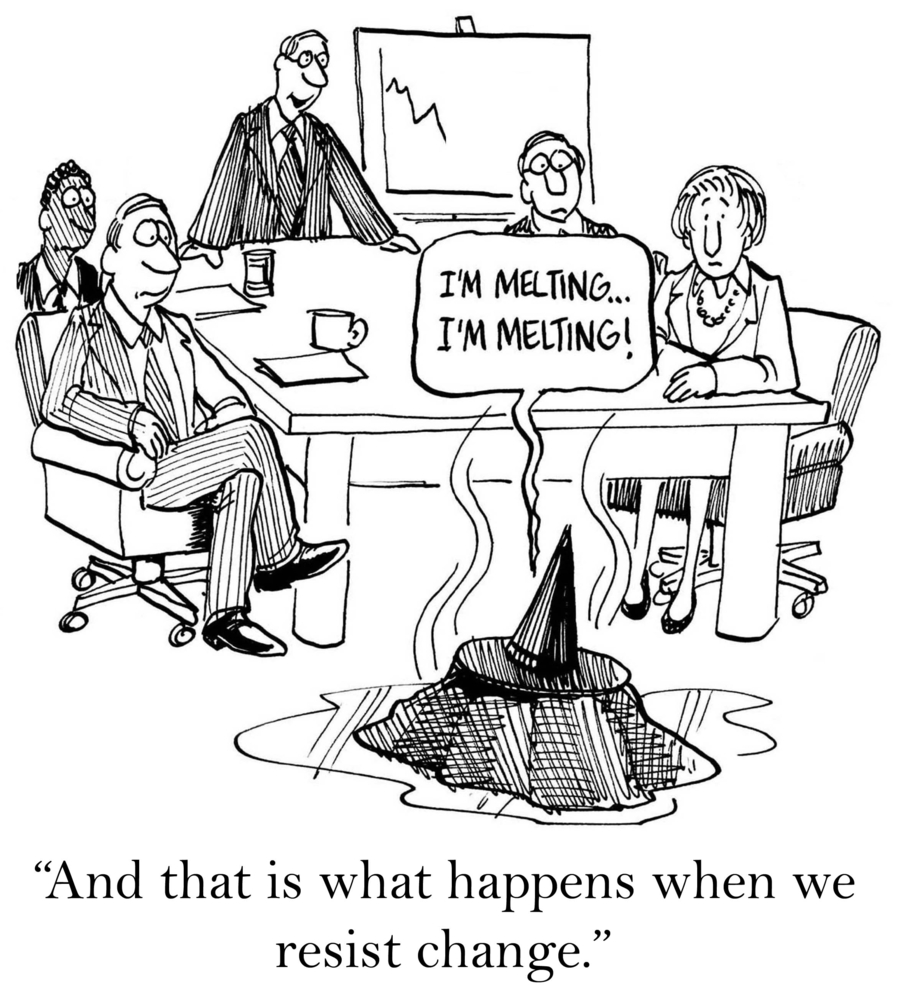


Reasons Employees Fight Change — and What Leaders Must Do About It
Despite the constant pace of change, change resistance remains a predictable and powerful force. Organizations evolve, strategies shift, and markets demand adaptation — yet employees often push back. While it may seem surprising, familiarity still feels safer than the unknown, even when the change is logical, necessary, or clearly beneficial.
Resistance to change is rarely about stubbornness alone. It often reflects concerns about loss — loss of:
People wonder whether they can succeed in the new environment, how expectations will shift, and what it means for their role. Even well-designed changes can trigger uncertainty, and uncertainty fuels hesitation.
Change leaders sometimes assume that if a change makes sense on paper, it will naturally gain traction. In practice, that assumption falls apart. Change management training participants learn that employees don’t resist the idea of change as much as they resist:
When clarity is lacking, change communication is inconsistent, or leadership commitment appears uneven, resistance intensifies.
There is also a practical reality at play. Change often requires people to:
That added cognitive and emotional load can feel overwhelming. Without the right support, even high performers can disengage or revert to old ways of working.
The leadership challenge is not to eliminate resistance — that’s unrealistic. The real work is to:
That means creating a compelling case for change, reinforcing what change success looks like, and ensuring that leaders at every level model the desired behaviors consistently over time.
The more precisely you anticipate why employees push back, the more effectively you can design a strategy that addresses resistance before it derails progress. Resistance is rarely random — it follows patterns. Based on change management simulation data, here are seven of the most common and consequential reasons employees resist change:
Understanding these dynamics doesn’t eliminate resistance, but it gives leaders a significant advantage. When you address the real concerns beneath the surface — not just the visible behaviors — you shift from reacting to resistance to proactively managing it.
The Most Effective Way to Address Change Resistance: The 3 I’s of Change Management
Change management consulting experts understand that resistance doesn’t decline through mandates or messaging alone. It is reduced — often significantly — when people feel connected to the process, informed about what’s happening, and actively engaged in making change work. That’s where the 3 I’s of change management come into play: Inclusion, Information, and Involvement.
Inclusion builds ownership, sharpens the quality of decisions through constructive debate, and increases the likelihood that employees will support what they helped create. Without it, even well-designed initiatives can feel imposed and disconnected from reality.
Just as critical, they need space to ask questions, raise concerns, and offer ideas. When communication flows in both directions, leaders gain real-time insight into where resistance is forming and why. That visibility allows for faster course correction and more credible leadership. Silence, on the other hand, creates a vacuum where workplace politics, assumptions and change rumors take over.
Clear accountability and strong cross-functional coordination are essential. When people are actively involved, they begin to build new habits, reinforce new ways of working, and see tangible progress. Without involvement, change remains theoretical — and resistance persists.
The 3 I’s are not independent levers; they reinforce one another. Inclusion builds early alignment, information sustains clarity and trust, and involvement drives execution. When leaders consistently apply all three, resistance becomes more manageable, momentum builds faster, and the odds of lasting change improve significantly.
The Bottom Line
Smart change leaders know that it is natural for people to initially fight change — even if the changes are positive and make sense. They understand the top seven reasons people oppose change and ensure that they get inclusion, information and involvement right during every step of the change process.
To learn more about reasons employees fight change and how to successfully manage large scale organizational change, download The 5 Science-Backed Lenses of Change Leadership to Get Right

Tristam Brown is an executive business consultant and organizational development expert with more than three decades of experience helping organizations accelerate performance, build high-impact teams, and turn strategy into execution. As CEO of LSA Global, he works with leaders to get and stay aligned™ through research-backed strategy, culture, and talent solutions that produce measurable, business-critical results. See full bio.



Aug 17,2026
 0
0

Feb 11,2019
13 K

Apr 18,2017
11 K

Nov 20,2016
6 K

Oct 02,2017
6 K
Explore real world results for clients like you striving to create higher performance