

Who Owns Corporate Culture?
Our organizational alignment research shows that corporate culture drives 40% of the performance gap between top-tier and lower-performing companies across revenue growth, profitability, customer loyalty, leadership effectiveness, and employee engagement. If the culture in your organization isn’t where it needs to be, the natural question is: what can you actually do to shift it? And more importantly, who truly owns corporate culture and has the power to shape it into a catalyst for higher performance — the leaders who set direction or the workforce that brings it to life every day?
Let’s Start with The Definition of Corporate Culture
We define corporate culture as the way work truly gets done on a day-to-day basis. Smart leaders know that your culture exists by either design or default. In other words, in every organization there is a combination of assumptions, behaviors, and business practices that define the collective attitude of a company’s workforce. In some organizations this combination has been carefully crafted over time to best execute a coherent strategy; in others it has reactively evolved without purposeful strategy and culture alignment.
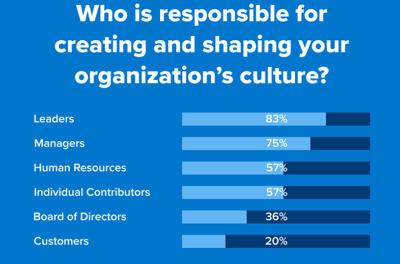
We asked this question as part of our annual employee engagement survey process to thousands of employees. The answers held a theme: Employees expect and count on leaders and managers to design, model, and commit to cultural norms. When employees strongly agree that leadership is committed to cultural values, they’re nearly And according to Gallup, when employees strongly agree that leadership is committed to cultural values, they’re nearly 10 times more likely to rate their culture as excellent.
When ownership of culture is unclear, performance and behaviors standards erode. Culture becomes slogans and taglines: visible, but not meaningful.
Everyone Owns Corporate Culture
While we agree that leaders need to set the direction and hold people accountable to agreed upon standards, we believe that both leaders and employees should own the culture of their organization. They just have different roles and responsibilities.
Otherwise, the corporate strategy is just wishful thinking.
Beyond setting up the cultural “way” to support and accelerate a particular business strategy, leaders need to understand their critical role as models of the desired behaviors. The way leaders act each and every day has a greater influence on their employees than they may realize. Whether they know it or not, leaders are in a fishbowl.
The workforce is always watching. If a leader’s behavior is out of line with the culture they espouse, you can be sure the leader’s behavior, rather than the desired workplace culture, is the one that will win out. Leaders need to understand that the amount of energy they focus on culture will determine how important it appears to employees.
Modifying and aligning culture takes a sustained and consistent effort over time.
If, for instance, leadership has determined that the company culture needs to support more decentralized decision making to best execute their strategy, employees (and their bosses) need to make sure they have the knowledge, decision making skills, and decision making authority to make decisions when it matters most.
The Bottom Line
Organizational culture matters. It is the glue between your strategy and your people. Sustainable and high performing cultures are the responsibility of both leaders and employees. Culture should be shaped by leaders and employees in concert in a way that is aligned with your corporate strategy.
To learn more about creating a high performance and purposeful culture, download The 3 “C’s” that Create High Performance Cultures

Tristam Brown is an executive business consultant and organizational development expert with more than three decades of experience helping organizations accelerate performance, build high-impact teams, and turn strategy into execution. As CEO of LSA Global, he works with leaders to get and stay aligned™ through research-backed strategy, culture, and talent solutions that produce measurable, business-critical results. See full bio.

Mar 19,2026
 0
0

Mar 16,2026
0
Mar 09,2026
0
Mar 05,2026
0
Mar 02,2026
0

Feb 23,2026
0

Feb 11,2019
12 K

Apr 18,2017
10 K

Nov 20,2016
6 K

Oct 02,2017
5 K
Explore real world results for clients like you striving to create higher performance