

Who Owns Corporate Culture? Why Leaders Are Accountable but Everyone Shapes It
Your corporate culture is either accelerating your business strategy or working against it. Who is responsible for making sure it delivers results?
Our organizational alignment research found that corporate culture accounts for 40% of the performance difference between high- and low-performing organizations across:
Yet many organizations struggle to answer a deceptively simple question: Who owns corporate culture?
The answer matters because when everyone assumes someone else owns culture, nobody takes responsibility for improving it.
What Is Corporate Culture — And Why Does It Matter?
We define corporate culture as how work truly gets done — the collective assumptions, behaviors, decisions, and business practices that shape organizational performance.
Every company has a culture, whether intentionally designed or allowed to evolve by default.
High-performing organizations deliberately align culture with business strategy. Underperforming organizations tolerate team norms that undermine strategic priorities.
The distinction is critical: Your strategy defines what you want to accomplish. Your culture determines whether people can accomplish it.
What Is Corporate Culture — And Why Does It Matter?
We define corporate culture as how work truly gets done — the collective assumptions, behaviors, decisions, and business practices that shape organizational performance.
Every company has a culture, whether intentionally designed or allowed to evolve by default.
High-performing organizations deliberately align culture with business strategy. Underperforming organizations tolerate cultural norms that undermine strategic priorities.
The distinction is critical: Your strategy defines what you want to accomplish. Your culture determines whether people can accomplish it.
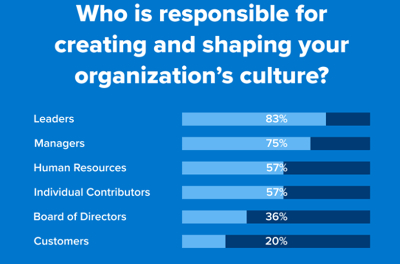
Our expert’s organizational health research, involving thousands of employees, reveals a consistent expectation: Employees look primarily to leaders and managers to establish, model, and reinforce cultural standards.
Employee Engagement and Organizational Culture Research: What Drives High Performance
Gallup research reinforces this finding. Employees who strongly agree that leadership is committed to their organization’s cultural values are nearly 10 times more likely to describe their culture as excellent.
That creates an important distinction between accountability and participation.
Leaders are accountable for culture. Everyone is responsible for bringing it to life.
When that distinction disappears, accountability weakens, inconsistent behaviors become normalized, and corporate values deteriorate into meaningless slogans.
How Leaders and Employees Share Ownership of Corporate Culture
Aligning culture with strategy
Identifying the behaviors, capabilities, and practices required to execute strategic priorities.
Modeling expected behaviors
Demonstrating cultural expectations consistently, especially under pressure.
Reinforcing accountability
Ensuring incentives, decisions, and consequences support desired behaviors.
Research by Edgar Schein emphasizes how leaders embed culture through what they consistently prioritize, measure, reward, and tolerate.
Employees notice discrepancies between leadership rhetoric and leadership behavior.
Our organizational culture assessment data shows that when leaders say one thing but reward another, employees believe the rewards.
Their responsibilities include:
Establishing team norms
Agreeing on behaviors that improve collaboration, accountability, and performance.
Making aligned decisions
Applying cultural expectations when solving problems and serving customers.
Constructively challenging misalignment
Addressing behaviors and practices that undermine shared commitments.
For example, a strategy requiring decentralized decision-making cannot succeed if employees lack the decision rights, capabilities, or confidence to make decisions.
Culture changes when employees consistently practice new behaviors — not when executives announce new values.
The Bottom Line
While we believe that corporate culture belongs to everyone, leadership must intentionally shape the conditions for strategic success. Then managers and employees must reinforce the behaviors that turn strategies into results. The organizations that outperform competitors understand that culture is not an HR initiative or an inspirational slogan — it is a strategic performance lever that must be deliberately aligned, consistently modeled, and collectively owned.
Is your corporate culture accelerating performance — or holding your organization back? Discover the three critical factors that separate high-performing cultures from the rest. Download Why Some Corporate Cultures Outperform Others — The 3 C’s of High Performing Cultures That Make the Difference to learn what it takes to build a purposeful culture that drives measurable business results.

Tristam Brown is an executive business consultant and organizational development expert with more than three decades of experience helping organizations accelerate performance, build high-impact teams, and turn strategy into execution. As CEO of LSA Global, he works with leaders to get and stay aligned™ through research-backed strategy, culture, and talent solutions that produce measurable, business-critical results. See full bio.




Feb 11,2019
 13 K

Apr 18,2017
11 K

Nov 20,2016
6 K

Oct 02,2017
6 K
Explore real world results for clients like you striving to create higher performance