


Career Development Conversations Matter
Career development conversations are one of the most underutilized tools for building:
Yet many new managers receive extensive training on managing projects, driving performance, and navigating their own careers while receiving little guidance on how to support the career growth of their direct reports.
That gap matters.
Employees want to know that their manager is invested in their future. When managers actively discuss career aspirations, growth opportunities, and development paths, they strengthen trust, increase engagement, and improve retention. Managers who make career development a regular priority are far more likely to build committed, motivated teams that consistently perform at a high level.
Organizational culture assessments show that the traditional annual performance review is rapidly losing favor. High-growth organizations increasingly rely on frequent coaching conversations and ongoing feedback rather than once-a-year evaluations.
This shift prompted an important question:
If more frequent performance conversations improve engagement, motivation, and performance, could more frequent career development conversations deliver similar benefits?
To find out, we examined the relationship between career development conversations and employee engagement and tested our findings through management development and career development training programs.
Employee Engagement Context
Let’s start by setting some context regarding employee engagement. We define employee engagement as the combination of:
Why Employee Engagement Matters
The business impact of engagement is substantial.
Organizations with highly engaged employees report:
By contrast, organizations with lower levels of employee engagement report:
When engagement rises, performance follows.
The Career Development Research
Earlier research found that annual employee engagement surveys are associated with higher levels of engagement. We wanted to determine whether career conversations followed a similar pattern.
Specifically, we examined whether more frequent discussions about career aspirations, advancement opportunities, skill development, and professional growth positively influence employee engagement.
The answer was clear: they do.
Applying the Career Development Research to Management Development
The findings have significantly influenced our new manager training programs.
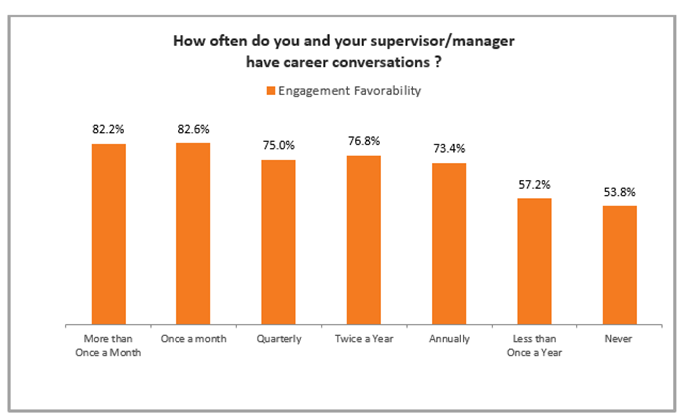
Compared to managers who held career development conversations less than once per year:
The message is straightforward: employees are significantly more engaged when managers consistently discuss their professional growth and future opportunities.
What Surprised Us Most
One of the most interesting findings was that quarterly career conversations produced engagement levels similar to annual conversations.
However, engagement increased dramatically when conversations became monthly.
Just as important, there was little difference between holding conversations once per month and more than once per month. This suggests that monthly career development conversations represent the optimal balance between impact and practicality.
For managers, that is good news. You do not need to schedule endless career discussions. A meaningful monthly conversation focused on growth, aspirations, and individual development plans can produce substantial engagement benefits.
The Bottom Line
Career development conversations are not simply about future promotions or long-term career planning. One-on-one engagement meetings demonstrate genuine investment in employees’ success. When managers regularly discuss growth opportunities, provide developmental support, and help employees navigate their career paths, they strengthen trust, deepen commitment, and reinforce the connection between individual success and organizational success.
The research is clear: managers who make career development conversations a monthly habit create more engaged employees, stronger retention, and better business outcomes.
Want to unlock higher engagement, stronger retention, and better business results? Download 10 Proven Ways to Boost Employee Engagement and Drive Better Business Results to discover the strategies that make the biggest impact.

Tristam Brown is an executive business consultant and organizational development expert with more than three decades of experience helping organizations accelerate performance, build high-impact teams, and turn strategy into execution. As CEO of LSA Global, he works with leaders to get and stay aligned™ through research-backed strategy, culture, and talent solutions that produce measurable, business-critical results. See full bio.



Aug 17,2026
 0
0

Feb 11,2019
13 K

Apr 18,2017
11 K

Nov 20,2016
6 K

Oct 02,2017
6 K
Explore real world results for clients like you striving to create higher performance