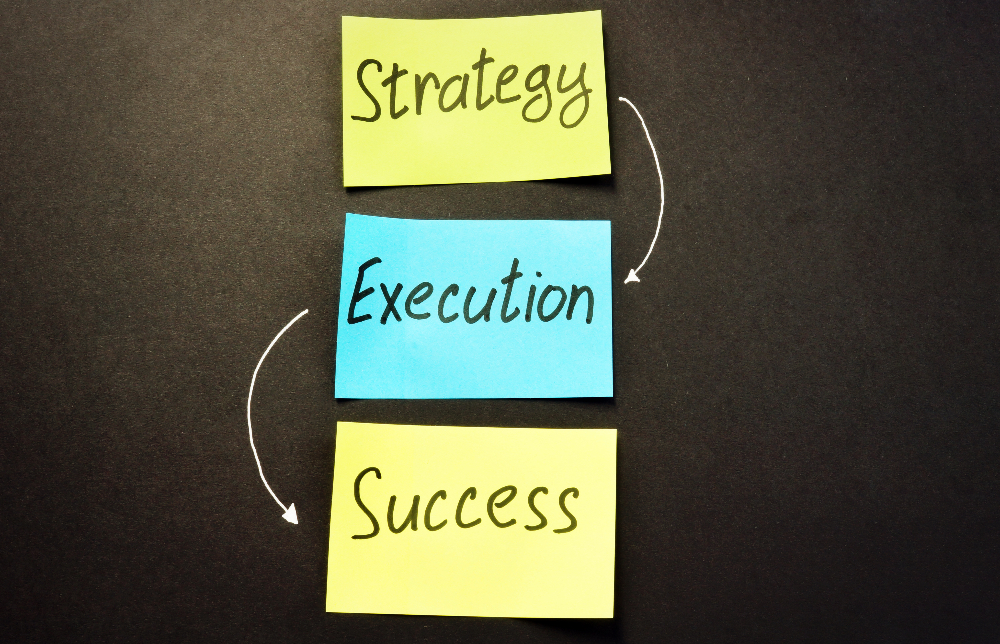


A brilliant strategy that nobody executes is just an expensive exercise in wishful thinking. We call that the strategy execution gap:
Executives spend days — sometimes weeks — during executive strategy retreats:
Yet too many return to business as usual, where competing priorities, entrenched behaviors, and unclear accountability quietly undermine their plans.
The problem is rarely a lack of strategic ambition. It is the strategy execution gap — the disconnect between what leaders intend to accomplish and how work actually gets done.
Our project postmortem experience reveals a recurring pattern: organizations underestimate the leadership discipline required to translate strategic intent into measurable results.
The Strategy Execution Gap Is a Business Performance Problem
Research reinforces why executives cannot afford to treat execution as an afterthought.
The implication is clear: Strategic advantage comes not from having the best-looking plan, but from consistently making better decisions and executing the critical few priorities that matter most.
3 Leadership Moves to Close the Strategy Execution Gap
Yet strategic clarity is not simply understanding the corporate vision. It requires leaders to make explicit choices about where to compete, how to win, and what not to pursue.
Before execution begins, employees must:
— Understand the strategic direction and critical priorities.
— Believe the strategy is credible and achievable.
— Commit to the tradeoffs and behaviors required for success.
The executive test: Can your leaders independently identify the same three strategic priorities — and explain what they will stop doing to achieve them?
A polished presentation followed by departmental briefings does not create strategic alignment. Real execution requires meaningful dialogue about what the strategy changes for each team.
After achieving leadership team alignment, engage employees in translating enterprise priorities into operational reality.
Every team should be able to:
— Translate strategic priorities into specific goals and decisions.
— Challenge assumptions and expose execution risks.
— Identify required changes in capabilities, processes, and behaviors.
— Agree on measurable outcomes and cross-functional dependencies.
The critical shift is from telling employees what the strategy is to engaging them in determining what must change to make it succeed.
High-performing teams need decision-making authority, clear guardrails, appropriate resources, and consistent performance expectations.
Leaders must establish an operating rhythm that:
— Protects priorities from competing initiatives and unnecessary distractions.
— Measures outcomes, not merely activity or effort.
— Removes obstacles that prevent cross-functional execution.
— Aligns resources and incentives with strategic commitments.
— Reviews progress frequently enough to correct course.
— Holds leaders accountable for results and required behaviors.
The objective is not tighter control. It is creating the conditions where employees can make the right decisions without waiting for executive permission.
The Bottom Line
The strategy execution gap is where competitive advantage is either realized or squandered. Closing it requires more than better planning, inspiring communication, or ambitious performance targets. It demands strategic clarity, meaningful employee engagement, and disciplined accountability. Leaders must actively involve employees in strategy design and implementation while relentlessly protecting the priorities that matter most. The question for your executive team is simple: Are you building an organization capable of executing your strategy — or merely getting better at presenting it?
To prevent your strategic plan from becoming another execution failure, download Why Great Strategies Fail — 3 Cascading Mistakes Leaders Overlook and discover the costly missteps that can quietly derail even the most promising strategies.

Tristam Brown is an executive business consultant and organizational development expert with more than three decades of experience helping organizations accelerate performance, build high-impact teams, and turn strategy into execution. As CEO of LSA Global, he works with leaders to get and stay aligned™ through research-backed strategy, culture, and talent solutions that produce measurable, business-critical results. See full bio.



Aug 17,2026
 0

Feb 11,2019
13 K

Apr 18,2017
11 K

Nov 20,2016
6 K

Oct 02,2017
6 K
Explore real world results for clients like you striving to create higher performance