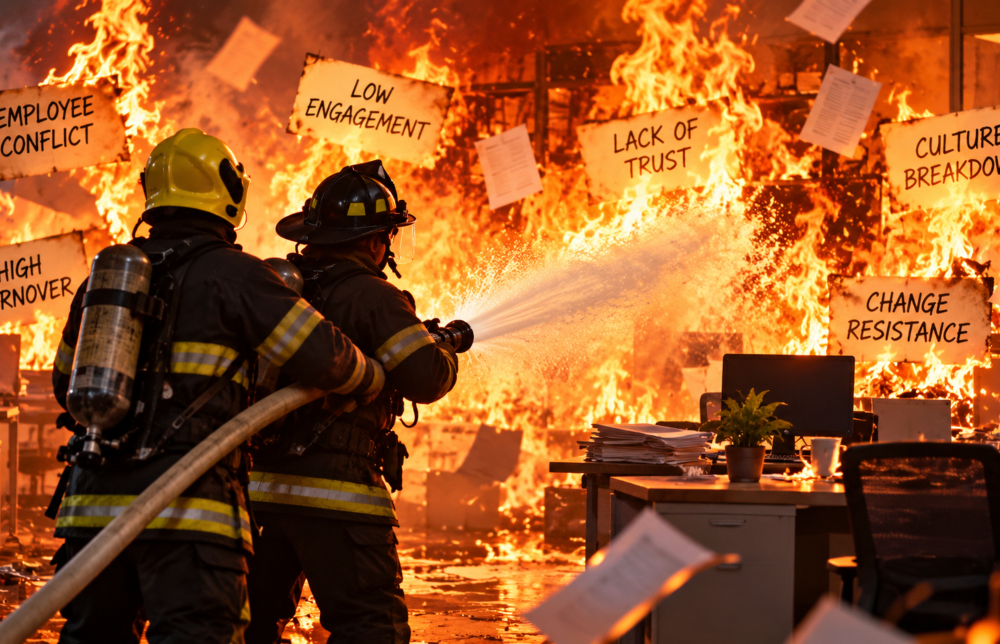


Bad Company Culture Definition: What Is It?
Company culture is the way work actually gets done within an organization. It reflects how employees think, behave, collaborate, make decisions, and respond to challenges. Culture includes both the visible and invisible forces that shape the workplace — from stated corporate values and leadership behaviors to the:
Organizational culture evaluations show that a bad company culture develops when workplace behaviors, leadership actions, and organizational systems undermine:
Over time, these unhealthy patterns become normalized and begin to shape how employees interact with one another, customers, and the business itself. This leads to employee disengagement, cultural misalignment, and performance decline.
Organizational cultures are not inherently “good” or “bad” in isolation. The real question is whether the culture supports and is aligned with both the workforce and the company’s strategic goals.
Healthy workplace cultures typically demonstrate:
Our research on organizational alignment shows that organizations with healthy, accountable, and strategically aligned cultures significantly outperform peers in revenue growth, profitability, employee retention, customer satisfaction, profitability, and long-term performance.
In contrast, bad company cultures often create environments where fear, politics, blame, or short-term pressure dominate decision-making. Employees may disengage, avoid speaking up, or prioritize self-protection over organizational success.
Companies such as Southwest Airlines and Patagonia are frequently cited for cultures that reinforce purpose, accountability, and performance. Conversely, organizations including Wells Fargo, Volkswagen, and the U.S. Department of Veterans Affairs have faced public scrutiny tied to cultural breakdowns that enabled unethical or damaging behaviors.
Common Signs of a Bad Company Culture
A toxic or unhealthy culture can reveal itself in many ways, including:
The consequences extend well beyond employee dissatisfaction. Research published in the Journal of Business Ethics has linked unethical workplace cultures to increased misconduct, weakened decision-making, and reputational damage.
When organizations lack a clear ethical “true north,” employees may gradually accept behaviors they would otherwise question. Over time, silence and avoidance become part of the culture itself.
A Research-Backed Example of Toxic Company Culture: 3M
One of the most widely cited examples of culture-driven ethical failure involved the chemical manufacturer 3M and the long-term production of PFAS-related compounds used in products such as non-stick cookware.
According to investigations by the Environmental Protection Agency and subsequent litigation, evidence accumulated over decades regarding potential health risks associated with these chemicals, including links to cancer and cardiovascular disease. Despite growing concerns, the compounds remained in widespread use for years before significant regulatory action occurred.
How can organizations continue harmful practices despite mounting evidence? Culture often plays a central role.
Research by Harvard Business School professor Amy Edmondson on psychological team safety demonstrates that employees are far less likely to raise concerns in environments where questioning authority is discouraged or punished. In unhealthy cultures, employees may learn that speaking up carries professional risk, while silence is rewarded.
The Human Impact of a Negative Workplace Culture
Culture shapes employee behavior more powerfully than most formal policies. Positive cultures can inspire innovation, trust, and commitment. Negative cultures can normalize avoidance, fear, and ethical compromise.
Employees in unhealthy environments may eventually disengage from their own values in order to fit organizational expectations. Leaders who ignore misconduct — or worse, reward it — reinforce the message that results matter more than integrity.
This is why culture cannot be treated as a “soft” business issue. It has a 40% impact on strategy execution, leadership credibility, employee wellbeing, customer trust, and financial performance.
The Bottom Line
Organizational culture is one of the most powerful forces shaping business success or failure. A bad company culture rarely appears overnight — it develops gradually through tolerated behaviors, weak accountability, and leadership inconsistency. Left unchecked, toxic workplace cultures can damage performance, erode trust, and create ethical failures that impact employees, customers, and the broader community.
To learn more about how to shape a healthy, high performing, and aligned company culture, download The 3 Critical Levels of Corporate Culture Every Leader Must Get Right

Tristam Brown is an executive business consultant and organizational development expert with more than three decades of experience helping organizations accelerate performance, build high-impact teams, and turn strategy into execution. As CEO of LSA Global, he works with leaders to get and stay aligned™ through research-backed strategy, culture, and talent solutions that produce measurable, business-critical results. See full bio.



Aug 17,2026
 0
0

Feb 11,2019
13 K

Apr 18,2017
11 K

Nov 20,2016
6 K

Oct 02,2017
6 K
Explore real world results for clients like you striving to create higher performance