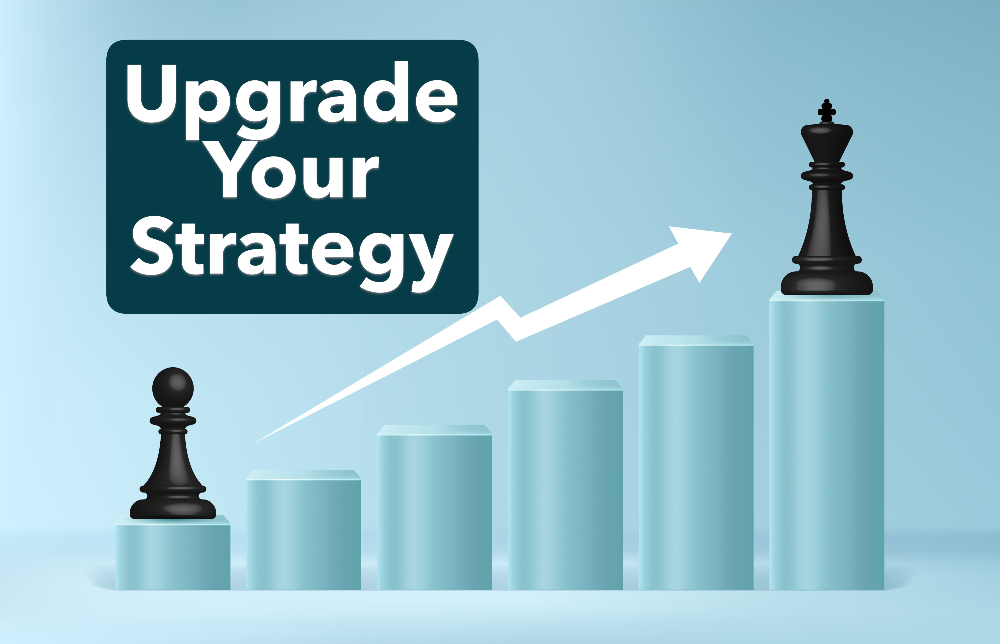
Upgrade your Strategic Planning Process: Top 7 Ways

Upgrade your Strategic Planning Process: Top 7 Ways
Facebook Twitter Email LinkedIn

Upgrade Your Strategic Planning Process to Get Better Results
If your strategy looks sharp on paper but struggles to gain traction in the real world, our organizational culture assessment data found that it’s probably not a messaging problem — it’s a process problem. Most organizations need to rethink how strategy is built, aligned, and activated if they want something that is understandable, winnable, and actually implementable.

The hard truth? The odds are not in your favor:

  • IBM found that fewer than 10% of well-formulated strategies are effectively executed.
  • Booz & Company reported that employees at 60% of companies rate their organization as weak at translating strategy into action.
  • Our own organizational alignment research shows employees have roughly 50% less confidence in the strategic plan than their leadership teams.

That strategic alignment gap is where strategies go to die.

Leaders consistently report frustration that their carefully crafted plans are not being executed with the speed, consistency, or quality they expect. Meanwhile, employees tell a different story — one where the strategy feels unclear, unconvincing, or disconnected from reality. Both perspectives are valid. And together, they point to a deeper issue: strategy is often built in isolation and deployed without true alignment.

A modern strategic planning process must do more than define direction — it must build belief, ownership, and commitment at every level.

7 Steps to Upgrade Your Strategic Planning Process

If strategy execution is where most organizations stumble, then the planning process itself needs a hard reset. A more effective approach doesn’t just define direction — it builds clarity, alignment, and momentum from the start. These seven steps significantly increase the odds that your strategy will actually get done.

  1. Scrap the Annual Ordeal
    Treating strategy as a once-a-year event is a relic. In a fast-moving environment, strategy must function as a living, breathing process — continuously shaped by new data, shifting priorities, and emerging risks. High-performing organizations build regular strategy sessions into their operating rhythm. These are not status updates, but focused discussions on progress, barriers, and required pivots.
  2. Select Only 2 or 3 Big Moves
    Most strategies fail under the weight of too many priorities. Spreading resources across five or six “strategic” initiatives almost guarantees mediocrity. Instead, identify the two or three big strategic moves that will truly differentiate your organization and drive meaningful impact. Then align time, talent, and capital accordingly — without compromise.
  3. Encourage Constructive Debate
    Strong strategies are forged through rigorous thinking, not polite agreement. Leaders must challenge assumptions, explore alternatives, and pressure-test ideas before committing. This is not about consensus for its own sake — it’s about making smarter choices. Productive tension leads to better decisions, provided it is grounded in data and mutual respect.
  4. Get Crystal Clear on the Current Reality
    A shared understanding of the present is the foundation for any credible strategy. Misalignment here creates friction everywhere else. If leadership believes the business is underperforming while employees think things are fine, execution will stall before it begins. Align on the facts — market position, performance gaps, and risks — so everyone starts from the same place.
  5. Evaluate Ideas Before Assessing Risk
    Too many teams kill bold ideas too early by focusing on risk first. Flip the sequence. Encourage leaders to bring forward their strongest growth or improvement ideas without immediate scrutiny. Once the best options are on the table, then evaluate the upside, downside, and trade-offs. This sequencing promotes innovation without ignoring reality.
  6. Get Top Leaders Fully Aligned as a Team
    Strategic planning is not a competition between functions — it’s a test of leadership cohesion. If leaders leave the room with different interpretations or priorities, the organization will fragment quickly. True leadership team alignment means shared ownership, clear trade-offs, and a commitment to act in the best interest of the enterprise — not individual silos.
  7. Actively Engage and Get Moving
    Momentum matters. Even the most compelling strategy will stall without clear first steps. Translate high-level direction into specific actions, ownership, and timelines. Involve stakeholders early so they help shape both the path forward and the initial execution. When people see how the strategy connects to their reality — and what to do next — progress accelerates.

Strategy execution is not a downstream activity. It is built — or undermined — during the strategic planning process itself. Organizations that recognize this shift their focus from producing strategy documents to building strategic capability.

The Bottom Line
Increase your chances of becoming one of the elite organizations that gets strategic planning and strategy execution right.  Re-think your strategic planning process in a way that is innovative, flexible, productive, and leads to successful implementation.

To learn more about how to upgrade your strategic planning process, download 3 Big Mistakes to Avoid When Cascading Your Corporate Strategy

Evaluate your Performance

Toolkits

Get key strategy, culture, and talent tools from industry experts that work

More

Health Checks

Assess how you stack up against leading organizations in areas matter most

More

Whitepapers

Download published articles from experts to stay ahead of the competition

More

Methodologies

Review proven research-backed approaches to get aligned

More

Blogs

Stay up to do date on the latest best practices that drive higher performance

More

Client Case Studies

Explore real world results for clients like you striving to create higher performance

More